Anthony Vondoom
Chef · Researcher · Author
Scroll
I was born in Sri Lanka and grew up in Piliyandala, where I attended Somaweera Chandrasiri Vidyalaya. A scholarship from the Grade 5 exam took me to Nalanda College in Colombo, and during those years I also earned a diploma in graphic design. As the civil war intensified, my father decided the family should join him in Sirmione, a beautiful town on Lake Garda in Italy.
I arrived at 16 speaking only English and Sinhala. On our second day, as we walked through the old town, we met Beppe Bignotti, who already knew my father from the nearby restaurant where he worked as a chef de partie. Beppe offered me some extra shifts as an apprentice. I started the next day and enjoyed it, but my mother didn’t like me working until 23:00, so Beppe hired me as an apprentice storekeeper instead, and I took night classes to learn Italian.
From there, things grew. Beppe’s son Angelo asked his father to let me learn pizza-making, and at 17 or 18 I began working alongside him. In the evenings I attended middle school in Rivoltella and earned my licenza media, which opened the door to high school in Desenzano. Once my Italian was solid, I left school to join the Bignotti family’s gelateria full time as an apprentice gelato maker. Without realising it, I was being trained in fermentation and flavour profiles, and that training has served me ever since.
After the gelateria, I moved to a boat rental company outside Sirmione castle, where I ran the front desk, managed a fleet and built a team. Then came Princess Cruises, then Nikki Beach in Sardinia, and then a recruiting agency offered me a stage in Egypt with Veratour. I accepted without hesitation, because I had always wanted to live there. In Egypt I visited many historic sites, and I finally began writing down my research.
I am now an independent researcher working across cognitive archaeology and systems theory, and the creator of the Deep Symbolic Systems Model (DSSM) — a framework for how societies stabilise shared practices into rituals, institutions and, eventually, monuments and writing. Alongside that work I have published policy research, kitchen standard operating procedures, and practical guides on food production scale-up. My corpus spans more than 100 open-access papers across OSF, Zenodo, SSRN and Academia.edu, along with three peer-reviewed publications in journals of Egyptian universities. The policy papers and culinary guides that sit outside the DSSM framework are collected here.
The DSSM is a framework for understanding how human societies stabilise shared practices — cooking, ritual, architecture, writing — into the symbolic infrastructure that holds a civilisation together across generations. It grew out of fieldwork in Egypt and has since been tested across five civilisations.
I am currently researching my ancestors. The surname I was born with — Anthonam Hettige — is a Sinhala house name built from two parts. Anthony Vondoom is the pen name and publishing alias I write under. The research is into the original name: Anthonam, a Christian baptismal name derived from the Latin Antonius, taken by ancestors navigating Portuguese and Dutch colonial rule in Sri Lanka; and Hettige, meaning “of the Hetti” — the Sinhala form of Chetty, the merchant caste. Dutch-era land registers, a 1954 Ceylon Government Gazette, and current genealogical records document these elements together. The full line is still being traced.
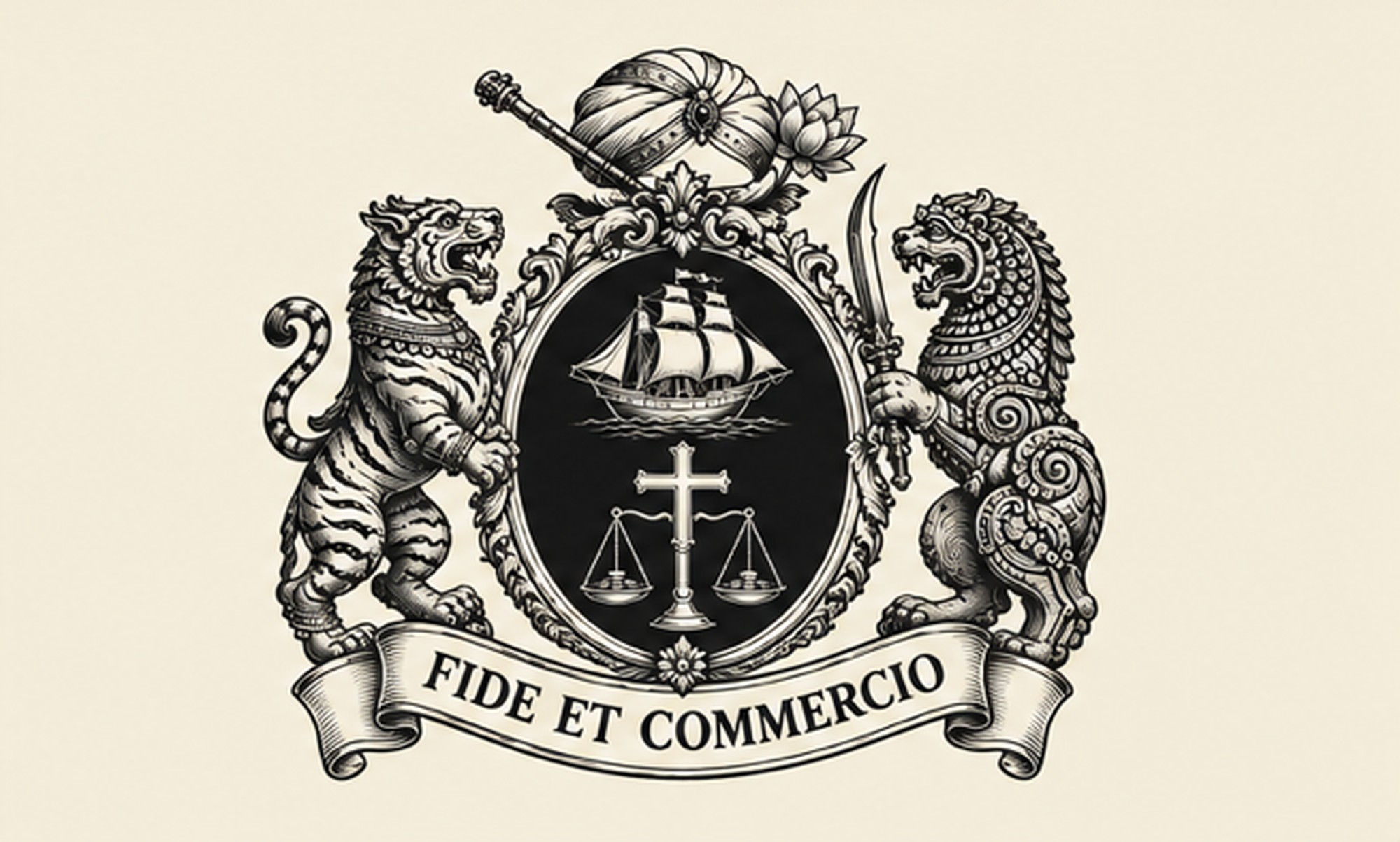
The parallel with my own life is not subtle. My ancestors crossed the Indian Ocean for trade, navigated four colonial regimes, changed their names to survive them, and held two identities at once — the merchant and the baptised Christian — encoding both in a surname that survived into the present. I left Sri Lanka at sixteen, crossed into Italian kitchens speaking no Italian, moved between countries and trades, and built a life that is also, at its core, about commerce and faith: faith in the work, commerce in the food. The motto was theirs first. It fits.
The emblem was made to hold that story in a single image. The research behind it is ongoing.
Two words that compress the double identity the surname carries: Fide — the faith encoded in Anthonam, the Christian baptismal name; Commercio — the commerce encoded in Hettige, the merchant house. The research into the full family line is ongoing.